


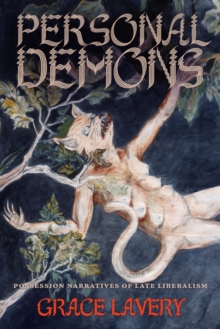
Personal Demons : Possession Narratives of Late Liberalism
Grace Lavery More by this author...£26.99Out 20 Oct 2026- Philosophy, Religion & Spirituality
- Pre-Order
Personal Demons offers a new theory of the relation between sex, desire, and personhood, asking what we should make of the many contemporary instances when bodies seem to want different things from the consciousnesses within them.
Grace Lavery maps the negative energies—demonic, incoherent, resistant—through which liberalism produces and disciplines its scapegoats. Through an examination of modern possession narratives, from racialized spectacles of bodily transformation and disguise to the liturgy of the Church of Scientology, Lavery unspools the knot of body, affect, and representation at the end of liberalism.
In the face of the uneasy bargains queer and trans liberal organizations made with the phobic state, Personal Demons elaborates a vision of queer collective living that does not assume a shared concept of interiority, taking the incompatibility of such concepts as the founding axiom for a coalition against the ideological regulation of bodies and minds.
A thrilling and utterly original book. Propulsively readable; Lavery’s luminous prose carries us through a captivating archive to reveal the surprising centrality of the trope of transsexual demonic possession to contemporary debates over embodiment, consciousness, agency, and the possibility of shared reality. When liberal rights claims have so spectacularly failed to defend trans kids (or trans adults), we need this book and Grace Lavery’s singular voice.”―Ann Pellegrini, coauthor of, Gender Without Identity “Grace Lavery is a daring, daunting, and dazzling writer. In Personal Demons she offers an utterly mesmerizing account of how transsexual subjectivity challenges neoliberal reason. Lavery writes a captivating and archly critical voice, and reads with uncanny sensitivity to both generic genealogy and textual detail. This is essential, urgent reading for anyone inhabiting the death throes of liberalism.”―Bill Brown, Karla Scherer Distinguished Service Professor in American Culture, University of Chicago